
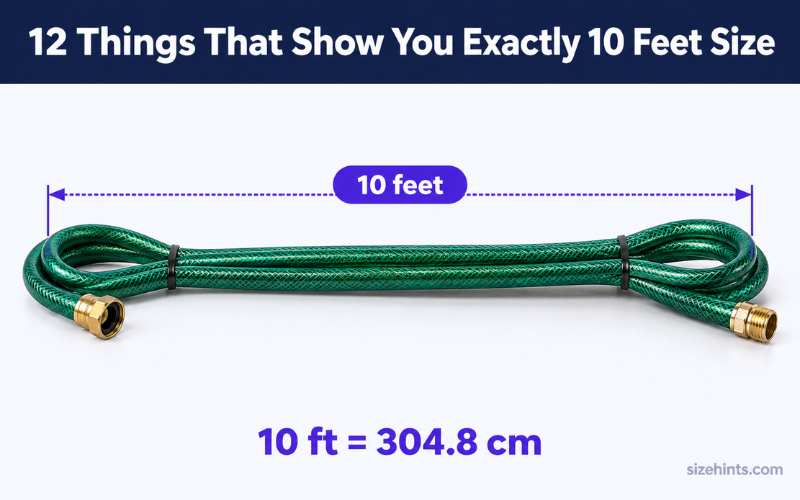
How long is 10 feet? Ten feet equals 120 inches, 3.33 yards, or 3.048 meters. It is a useful length to picture when arranging furniture, measuring a room, planning a garden, or choosing materials for a home improvement project. Yet imagining this distance without a measuring tape can be difficult.
Everyday objects make the measurement easier to understand. A long dining table, a section of garden hose, or a row of measuring sticks can help you visualize the distance. Whether you are shopping for furniture, working on a DIY project, completing a school assignment, or organizing an office, familiar comparisons can help you estimate space before making a purchase or starting work.
[Quick Answer Shortcode]
How Long Is 10 Feet?
Ten feet is a length of 120 inches, equivalent to 3.33 yards. In metric measurements, it is approximately 3.05 meters. This is a substantial distance for many household objects, although it is shorter than the length of some large rooms and outdoor structures.
You may encounter this measurement when buying long furniture, planning a storage area, installing decorative lighting, or measuring materials for a construction project. It can also help when deciding whether a large item will fit against a wall or inside a garage.
One simple way to picture the length is to imagine ten standard 12-inch rulers placed end to end. Each ruler represents one foot, creating a combined span of ten feet. You could also use a tape measure to mark the distance on the floor.
Having a visual reference is useful because product photographs can make objects look smaller or larger than they really are. Checking the actual dimensions before buying or building helps prevent unpleasant surprises.
[Conversion Table Shortcode]
How Big Is 10 Feet?
Ten feet is long enough to stretch across a significant portion of many rooms. Imagine looking along a long dining table or across the width of a spacious living room. The distance becomes easier to picture when you connect it to something familiar rather than relying on a number alone.
Your own body can provide a rough reference, too. An adult’s arm span may be close to their height, but individual proportions vary considerably. Someone who is around five feet tall would need approximately two arm spans to cover ten feet, assuming each span is close to five feet.
Paper provides another useful comparison. A standard US letter-size sheet measures 11 inches along its longest side. Ten feet is a little longer than ten sheets arranged end to end, so a row of eleven sheets would extend beyond the target.
For practical tasks, a measuring tape is more dependable than visual estimation. Use familiar objects to imagine the distance, then verify the measurement before cutting materials, installing fixtures, or purchasing large furniture.
[Interactive Ruler Shortcode]
Related Post: 12 Common Things That Show You Exactly How Long Is 9 Feet
12 Common Things That Are 10 Feet Long
The following objects offer practical ways to picture a 10-foot distance. Some can be measured or purchased at exactly this length, while others are approximate examples. Product sizes vary, so check the dimensions before treating any household item as an exact reference.
| Everyday Item | Actual Size |
| 1. Standard Room Curtain Track | 10 feet long |
| 2. Garden Hose Section | Exactly 10 feet long |
| 3. Large Dining Table | About 10 feet long |
| 4. Decorative Outdoor Light Strand | 10 feet long |
| 5. Five Two-Foot Shelving Boards | Exactly 10 feet combined |
| 6. Long Workshop Workbench | About 10 feet long |
| 7. Extension Cord | 10 feet long |
| 8. Outdoor Canopy Side | 10 feet along one side |
| 9. Fabric Roll Section | 10 feet long |
| 10. Garden Edging Strip | 10 feet long |
| 11. Long Storage Rack | About 10 feet wide |
| 12. Rope for Outdoor Projects | Exactly 10 feet long |
1. Standard Room Curtain Track
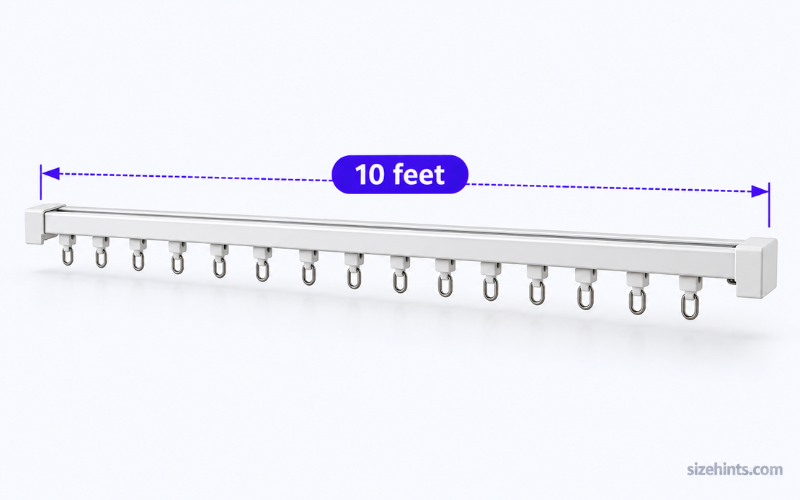
A curtain track measuring exactly 10 feet provides a straightforward reference for this length. Curtain tracks are available in different sizes, and some models can be cut or joined to suit a window or wall. A track with a confirmed 10-foot length gives you a rigid, straight comparison that is easy to measure.
Imagine installing it above a wide window or across a wall with several window panels. The distance from one end to the other demonstrates how much horizontal space ten feet covers.
This comparison is useful when planning curtains for a living room or deciding how much wall space a window treatment will occupy. For example, you might measure a wall before ordering a track to make sure it fits between two corners. Check whether the product dimensions include its end fittings, since those can affect the installed span.
2. Garden Hose Section
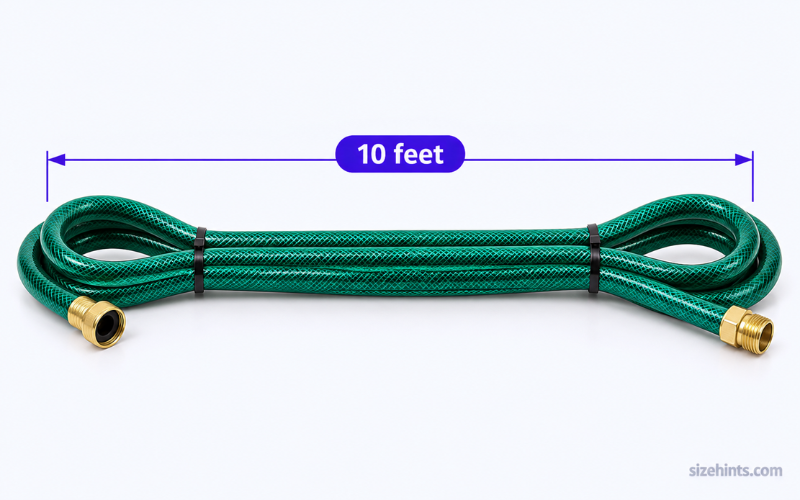
A garden hose cut to exactly 10 feet is a flexible, practical way to visualize the measurement. Unlike a rigid board, a hose can bend and coil, so its actual length is easiest to understand when it is laid straight on the ground without stretching.
Imagine unrolling the hose across a patio. Its end-to-end distance gives you a clear picture of the space covered by ten feet.
This comparison is particularly helpful when planning a garden watering setup. For example, you can use a measured hose section to check whether a nearby tap is positioned close enough to reach a row of plant pots. Remember that a coiled hose looks much shorter than its actual length. If you need an accurate reference, straighten it and measure along its length rather than estimating the distance between its ends while it is curved.
Related Post: 10 Common Things That Show You Exactly How Long Is 8 Feet
3. Large Dining Table
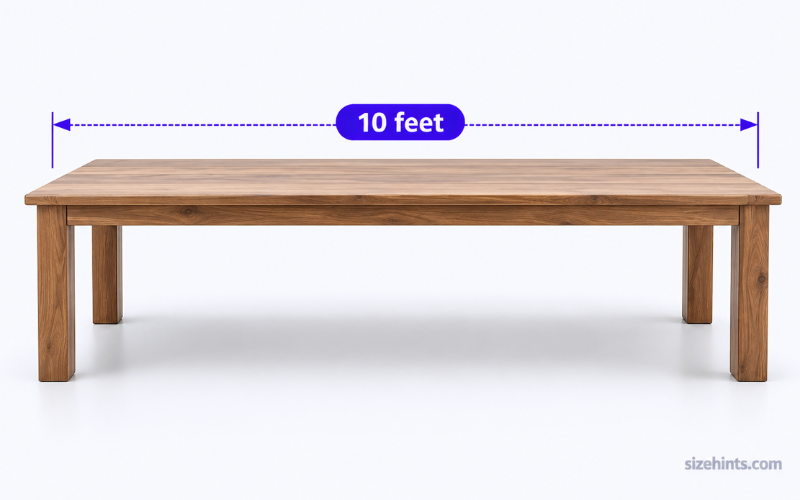
A dining table approximately 10 feet long provides a familiar furniture comparison. Tables of this size are often used in large dining rooms, banquet spaces, or homes where people regularly gather for meals. However, dining tables vary considerably in length, so not every large table will measure ten feet.
Picture a long table with chairs arranged along both sides. Looking from one end to the other helps you understand the distance without needing to imagine an abstract measurement.
This example is useful when planning a dining area or choosing furniture for a large room. Before buying a table, measure the available floor space and allow room for chairs to slide out. A table may fit against a wall but still leave insufficient clearance for comfortable movement. Checking the listed dimensions is more reliable than judging its size from a photograph.
4. Decorative Outdoor Light Strand
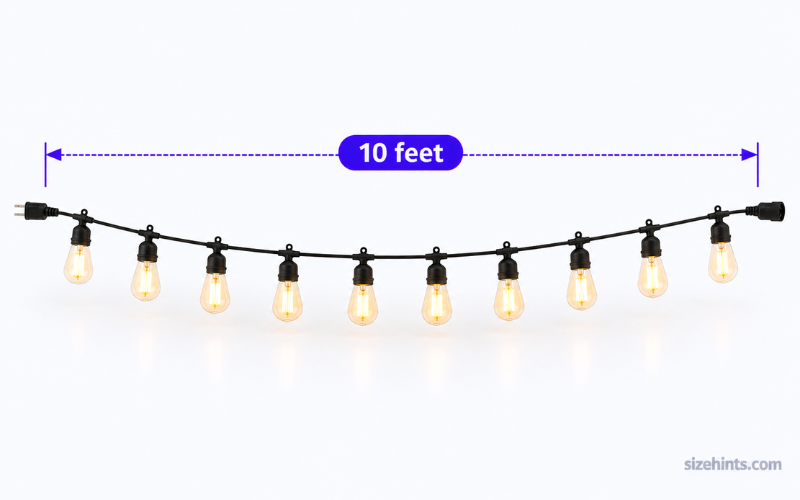
A decorative light strand measuring 10 feet from end to end offers an easy comparison for indoor or outdoor decorating. These lights are often used along shelves, around windows, across balconies, or on small patio structures. Some strands include an unlit section near the plug, so the illuminated length may differ from the total length.
Lay the strand in a straight line to see the full distance. Avoid pulling tightly on the wiring, since the goal is to measure its natural length rather than stretch it.
For example, a 10-foot strand can help you plan a decorative border along a shelf or a section of railing. Check the packaging to determine whether the stated length refers to the complete wire or only the illuminated portion. When the lights are gathered into a bundle, their total length is difficult to judge, making this a good example of why measurements matter.
5. Five Two-Foot Shelving Boards
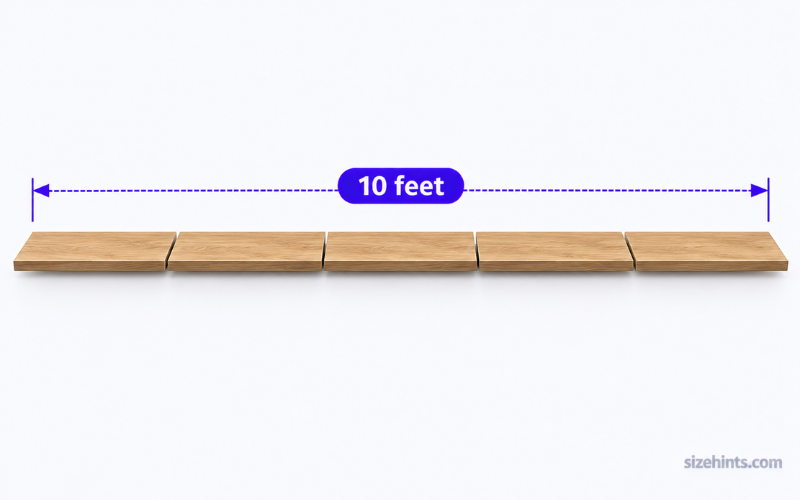
Five boards measuring exactly 2 feet each create a combined length of 10 feet when arranged end to end. This comparison works well because the pieces have a known size and can be laid out in a straight line.
Place the boards on a clear floor, lining up their ends carefully. The resulting span shows the distance directly and helps you understand how ten feet compares with common building materials. If the boards are each precisely 24 inches long, their combined length is 120 inches.
This method is useful when planning shelving, a workshop layout, or a long storage surface. For instance, someone installing shelves along a garage wall can arrange measured boards on the floor to estimate the overall run before purchasing materials. Allow for gaps, overlaps, or cutting when applying the comparison to an actual construction project. Five equal pieces make the measurement easier to remember.
6. Long Workshop Workbench
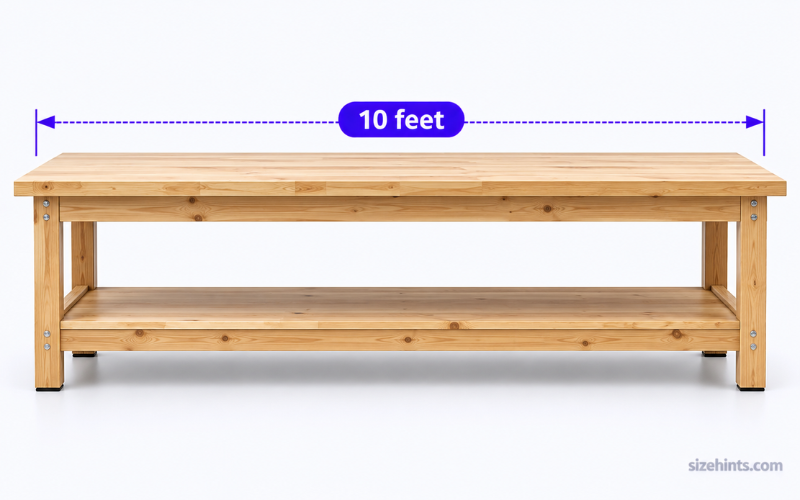
A workbench approximately 10 feet long is a useful reference for garages, craft rooms, and workshops. Long benches provide space for tools, materials, and equipment, making their dimensions relevant to people planning a home workspace.
Imagine standing at one end of the bench and looking along its entire top. The straight, rigid surface makes the distance easier to picture than a flexible object that bends or coils.
This comparison is helpful when arranging tools or deciding how much wall space to reserve for a work area. For example, a hobbyist building furniture may need a long bench for assembling components. Before buying one, check the overall length, depth, and clearance around the bench. A product listed as ten feet long may also have handles, end frames, or other features that affect the space it occupies.
Related Post: 10 Common Things That Show You Exactly How Long Is 8 Feet
7. Extension Cord
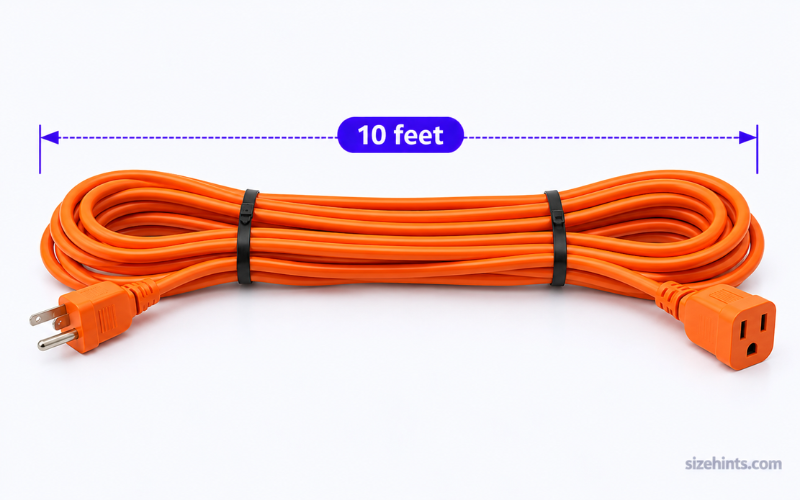
A 10-foot extension cord provides a compact and familiar way to visualize this length. Extension cords are available in many standard sizes, and a product specifically labeled as 10 feet can serve as a convenient measuring reference.
Lay the cord straight along a floor or work surface to see how far it extends. Avoid stretching it or pulling forcefully at either end. A coiled cord may look much shorter, which is why straightening it helps reveal its actual length.
This example is useful when planning a home office or arranging equipment in a workshop. For instance, you can use a 10-foot cord to estimate the distance between a wall outlet and a desk before deciding where to place the furniture. Always check the actual product length and electrical rating before using a cord. Its length helps visualize distance, but it does not determine whether the cord is suitable for a particular appliance.
8. Outdoor Canopy Side
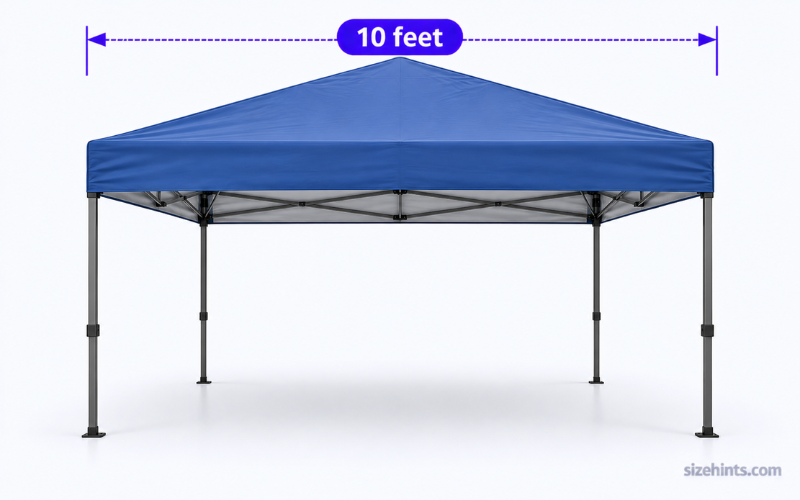
An outdoor canopy with a side measuring 10 feet offers a helpful reference for garden parties, patio seating, and temporary outdoor shelters. Canopies come in many shapes, including square and rectangular designs, so one side may measure ten feet without the entire structure having that dimension.
Picture a straight edge running from one corner of the canopy to the next. That side provides a clear reference for the horizontal distance, while the canopy’s overall shape helps show how length and width combine to define a covered area.
This comparison is useful when deciding whether a shelter will fit over outdoor furniture. For example, before purchasing a canopy, measure the patio and check the product’s full dimensions. Leave enough space around the structure for its frame, supports, and safe access. A ten-foot side does not necessarily mean the canopy will cover a ten-foot-long seating area once its supports and shape are considered.
9. Fabric Roll Section
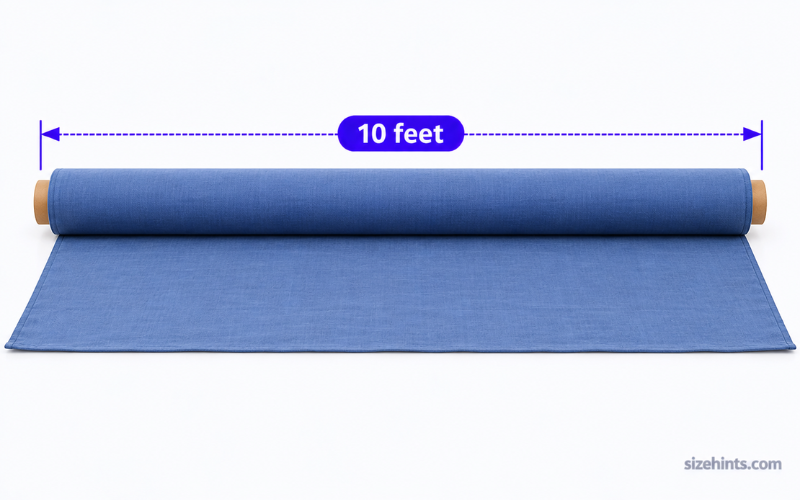
A fabric section cut to exactly 10 feet is a useful comparison for sewing, upholstery, and home decoration. Fabric is typically measured along its length, while its width is listed separately. This means two pieces can both be ten feet long but contain very different amounts of material.
Spread the fabric flat across a clean floor or large table. Measure from one cut end to the other without stretching the material. This creates a clear view of the full distance.
For example, someone making curtains or a table runner can use a ten-foot fabric section to plan the amount needed for a project. Remember that hems, seams, pattern matching, and folds may require extra material beyond the finished dimensions. Fabric can also wrinkle or gather, making it appear shorter than it really is. Laying it flat gives you a more reliable visual reference.
Related Post: 12 Common Things That Show You Exactly How Long Is 7 Feet
10. Garden Edging Strip
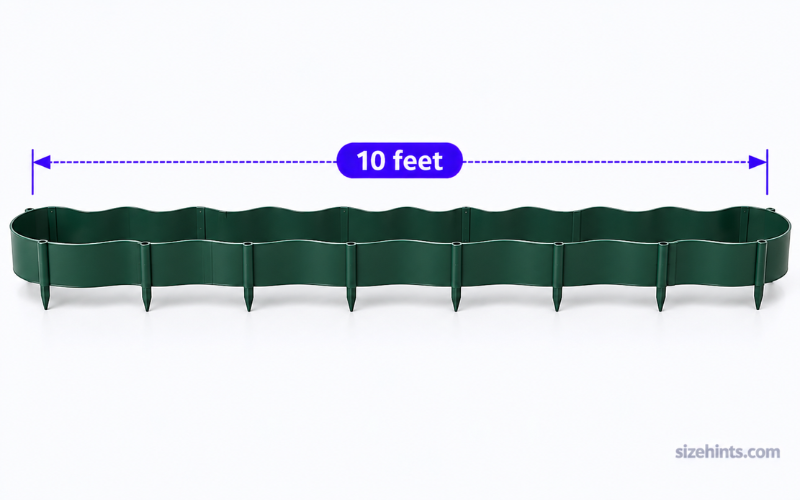
A garden edging strip measuring exactly 10 feet provides a useful reference for landscaping. Edging is used to separate flower beds from lawns, outline paths, or create a boundary around planting areas. Depending on the material, it may be flexible or rigid, but its stated length provides a clear comparison.
Lay the strip in a straight line along the ground to see how far ten feet extends. If it is flexible, avoid measuring it while it curves around a flower bed because the distance along the strip will differ from the straight-line distance between its ends.
This example is useful when planning a garden border. For instance, a gardener might measure a section of lawn before buying edging to determine how much material is needed. Check whether the product’s stated length refers to one strip or several connected pieces, and allow for joins or overlaps during installation.
11. Long Storage Rack
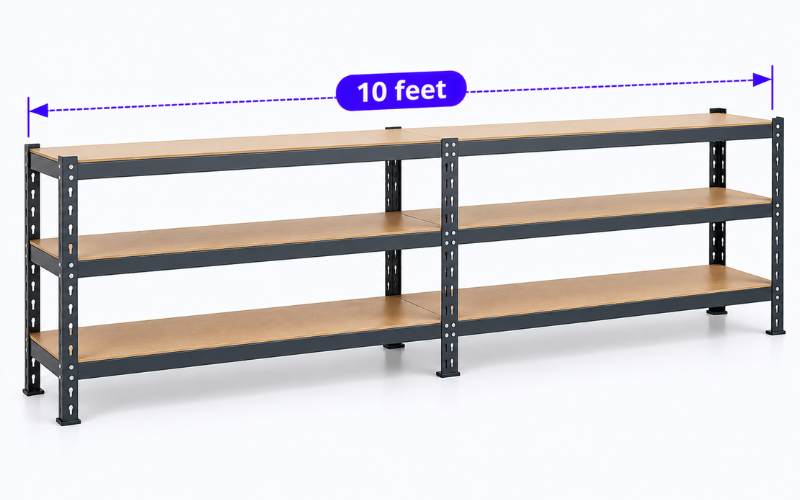
A storage rack approximately 10 feet wide can help you picture the measurement in a garage, warehouse, or utility room. Large racks are designed to hold boxes, equipment, containers, or other stored items, although their widths vary depending on the number and size of their sections.
Imagine looking across the rack from its left end to its right end. Because the frame is rigid and usually straight, it offers a clear visual reference for a ten-foot span.
This comparison can be especially useful when organizing a garage or planning storage along a wall. For example, you might measure a wall before buying a multi-section rack to ensure it fits without blocking a doorway. Check the rack’s overall assembled width rather than adding the advertised widths of individual shelves without accounting for connecting frames or end supports.
12. Rope for Outdoor Projects
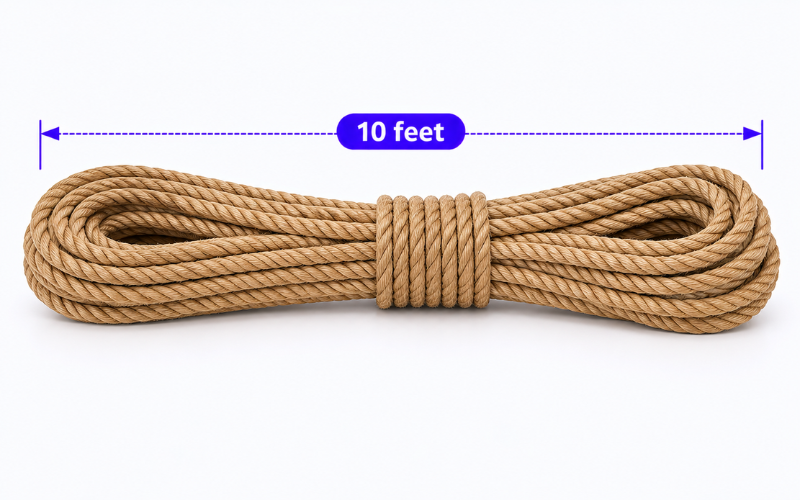
A rope cut to exactly 10 feet is one of the simplest ways to create a portable reference. It is easy to carry, store, and use for marking distances in a garden, at a campsite, or around a home improvement project.
Lay the rope in a straight line without pulling it excessively. Mark both ends if you want to use it again as a quick measuring aid. This makes the length easier to reproduce without needing to remember the distance visually.
For example, you can use a measured rope to estimate the spacing between garden stakes or mark out an area for outdoor furniture. Keep in mind that some ropes stretch under tension, especially when made from elastic or loosely woven materials. For the most dependable result, measure the rope before using it and avoid treating an unmeasured piece as an exact ten-foot reference.
FAQs
1. How many centimeters is 10 feet?
Ten feet equals 304.8 centimeters. To convert feet into centimeters, multiply the number of feet by 30.48. This conversion is useful when comparing furniture dimensions, measuring rooms, planning construction projects, or working with product specifications that use metric units.
2. What is exactly 10 feet long?
A rope, garden hose, curtain track, or extension cord can be measured or purchased at exactly 10 feet. Five boards measuring exactly 2 feet each also combine to make this length when placed end to end without gaps or overlaps. Always verify the actual dimensions of an item before using it as an exact reference.
3. Is 10 feet considered long?
Yes, ten feet is a substantial length for many household objects. It can span a large section of a room and is longer than many standard furniture pieces. However, whether it seems long depends on the setting. Ten feet may feel considerable in a small bedroom but relatively short across a large workshop.
4. How do I measure 10 feet without a ruler?
A tape measure is ideal, but you can use known-length objects to estimate the distance. For example, five accurately measured 2-foot boards placed end to end create ten feet. If you only need a rough estimate, use a familiar object of known length several times, then verify the result when accuracy matters.
5. What does 10 feet look like?
Imagine a long dining table, a straight garden hose section, or five 2-foot boards lined up end to end. These examples show how the distance stretches across a room or outdoor area. A visual comparison can help you estimate space, but direct measurement is more dependable when something must fit precisely.
6. What household object is 10 feet long?
A long curtain track, an extension cord, or a decorative light strand may measure ten feet. Some garden hoses and ropes are also sold in this length. Sizes vary between products, so check the label or measure the object before relying on it to represent exactly ten feet.
7. How many millimeters is 10 feet?
Ten feet equals 3,048 millimeters. One foot is exactly 304.8 millimeters, so multiplying that figure by ten gives the total. Millimeters are useful when working with detailed construction plans, workshop projects, and materials where small differences in size can affect the final fit.
8. What is the easiest way to visualize 10 feet?
The easiest method is to picture five 2-foot boards arranged end to end. You can also measure a 10-foot rope or extension cord and lay it straight across the floor. These references create a clear visual example and are more reliable than guessing the length of an unfamiliar object.
Related Post: 12 Things That Show You Exactly 6 Feet Size
Conclusion
How long is 10 feet becomes easier to picture when you connect the measurement to everyday objects. Five two-foot boards provide an exact comparison, while a long dining table, a garden hose, or an extension cord can help you imagine the distance in familiar settings.
Use these references when planning furniture layouts, choosing materials, or measuring an area for a home improvement project. If the fit needs to be precise, confirm the dimensions with a tape measure before buying, cutting, or installing anything. A small amount of measuring can save money and frustration later. Remember the five-board comparison: five equal pieces, each two feet long, create one ten-foot span.
